
 EN
EN



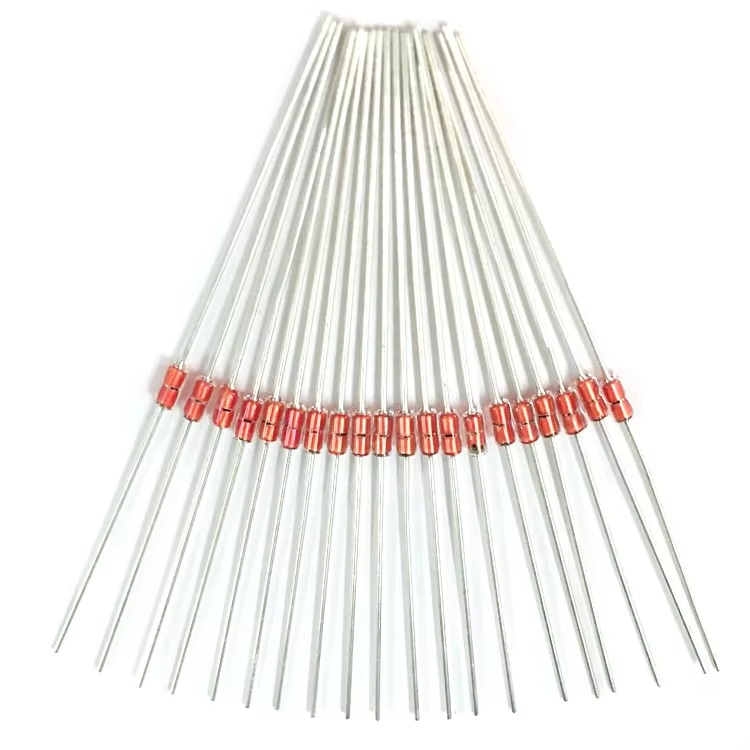
Resettable Overcurrent Protection via SMD Thermistors
Self-Resetting Mechanism of SMD Thermistors: The PTC Effect in Miniature Form
In addition to providing miniaturized self-resetting overcurrent protection, SMD thermistors utilize the Positive Temperature Coefficient (PTC) effect. In a thermistor, excessive current triggers a PTC event, with frozen resistance jumping thousands of times in mere milliseconds (due to Joule heating). This not only permanently protects the component(s) in the current path, but also resets the PTC in series with the current path. This self-resetting feature is unlike a conventional fuse. PTCs aid the continued operation of the overall system during routine brief power surges/fault conditions, which most engineers appreciate. Temporary overloads of the circuit are a feature, not a defect, of these devices. PTCs have been down to sizes suitable for 0201 packages. This means the devices take up less than one square millimeter of PCB (printed circuit board) area.
SMD thermistors are made out of solid state components which gives them an advantage when it comes to shocks and vibrations. These types of components are ideal for automotive and industrial systems as they must go through a lot of vibration. While fuses have their purpose in handling very high surges of current that can go over 10kA, for long term cost SMD thermistors are the best. In faulty scenarios that repeat frequently like in power supply units and motor controls, SMD thermistors can give about 60% savings on maintenance costs. During operation, the components (ceramic or polymer based) gives consistent trip points along the range of -40°C to +125°C with a maximum of 7% variation.
Key Selection Criteria for Overcurrent Protection Design SMD Thermistors
Voltage Rating, Ihold and Ambient Temperature in PCB Designs
When selecting SMD thermistors, there are three important aspects that need to be taken into consideration: voltage rating, hold current (Ihold), and ambient temperature. The voltage rating must be greater than the maximum value of the expected sighted circuit from the thermistor to eliminate the risk of dielectric breakdown. This is important for high-power applications like USB-C PD ports and industrial control panels where there are voltage spikes. The hold current for SMDs is usually in the range of 30 milliamps and 14 amps where the positive temperature coefficient (PTC) increases resistance and causes the current to flow above the hold value. Additionally, operating parameters and rated temperature of the thermistor are important. Devices rated for operation at 25 degrees Celsius often begin to trip and reset at 40 degrees Celsius due to thermal derating. Design engineers must consider the heat from adjacent components.
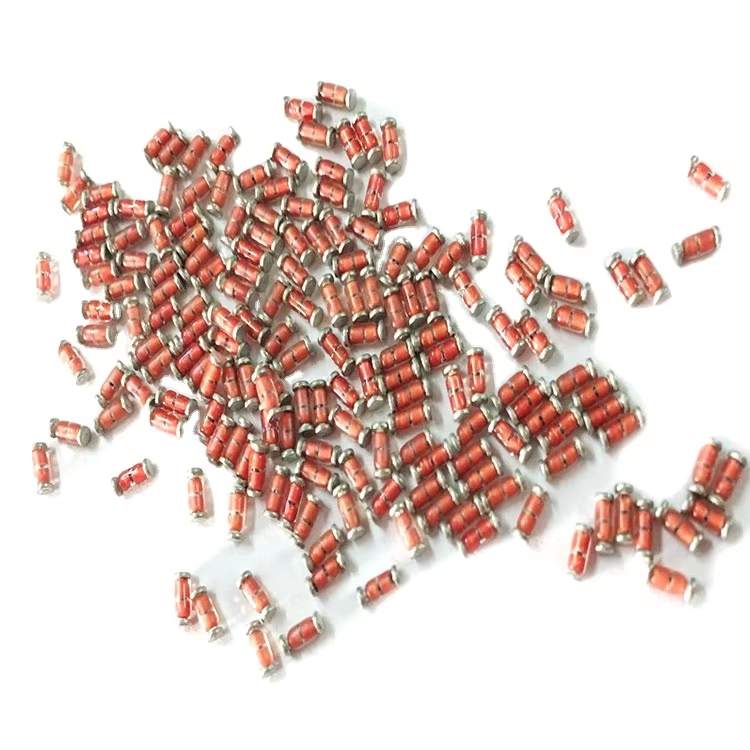
Proximity of processors and power management ICs raises local board temperatures by 15 to 20 degrees Celsius, potentially reducing the effective hold current by close to 33 percent. Misestimations of these numbers lead to premature shutdowns that disrupt operational continuity, or dangerously delayed reactions of fault situations.
Balancing SMD Package Sizes 0201 vs 1206, Thermal Behavior, and Dissipated Power
When designing electronic circuits, size has a significant influence on component overcurrent protection behavior. 0201 and 0402 packages are able to maximize board real estate, especially in the case of wearable and IoT devices. However, because of their small size, these components will heat up quickly and will activate overcurrent protection circuits in mere milliseconds. In contrast, 0805 and 1206 packages can withstand higher amounts of continuous current, up to 5 Amperes. Hence, they are suitable for harsh environments, such as automotive entertainment systems, where reliability is critical. The tradeoff is that for larger packages, with their higher thermal mass, they have thermal response times that are 15% to 40% slower, therefore posing a design challenge for engineers to determine if board real estate or thermal response time is more important for the intended function of the end product.
Thermal response: 0402 devices are able to identify faults almost twice as quickly as 1206 devices, but can handle ~60% less energy before failing.
Power handling: 1206 packages can dissipate up to 1.2 W while 0201 can only dissipate 0.25 W, making them suitable for motor-drive and high-current power rail applications.
PCB layout constraints: 0201s are sometimes required in tightly packed designs, but thermal reliefs and isolation are needed to avoid cross-heating from adjacent components.
Important Performance Differences in Ceramic and Polymer SMD Thermistors.
Material-Specific Behaviors: TCR, Trip Time, Hold/Trigger Current Ratios.
The performance disparities between ceramic and polymer SMD thermistors is primarily due to their distinct materials. For instance, ceramics are often constructed from doped barium titanate which provide superior thermal conductivity and stability. This type of material delivers consistent TCR values of around ±4% per °C, and exhibits a hold-to-trigger current ratio of approximately 1.5 to 1. This minimizes the possibility of false tripping in circuits sensitive to voltage fluctuations. In contrast, polymer thermistors behave differently because they use a carbon-loaded polymer matrix.
They can respond much faster, sometimes in about half a second, but their TCR drifts are ±15% per degree. Therefore, when temperature changes are inconsistent, these units can become unresponsive. The primary distinctions in these approaches come down to…
Trip dynamics: Ceramics respond more linearly and gradually to temperature variations while polymers respond more instantaneously to overcurrents
Hold/trigger ratio: Ceramics have tighter ratios (1.5:1) assisting in holding accuracy; polymers usually have a ratio of 2:1, increasing the chance of false triggers
Long-term reliability: after 10,000 cycles, ceramics have < ±5% TCR drift for their life, polymers can have ±20% drift, making them unreliable for mission-critical or long-lifecycle applications
For PCBs where accuracy is essential—particularly those used to power analog sensors or low-noise amplifiers—ceramic SMD thermistors are the clear choice for consistency, while polymer counterparts are ideal when speed and multiple resets are preferred to accuracy.
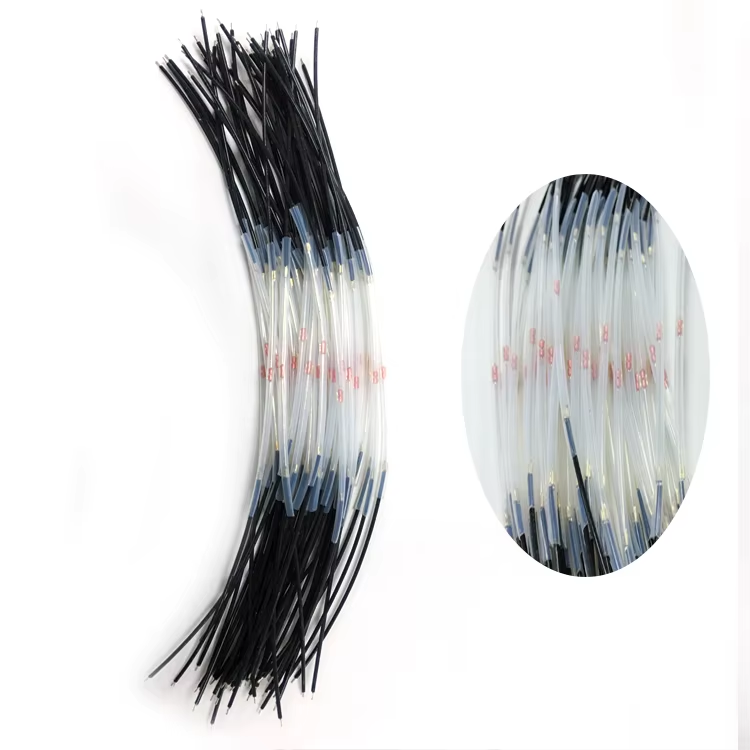
Practical Uses of SMD Thermistors in Today's Electronics
Protection of USB-C PD With SMD Thermistors Made From Polymers
Compact resettable polymer SMD thermistors in 0402 packaging (about 1mm by 0.5mm) provide overcurrent protection for USB-C Power Delivery ports. In the event of short circuits or power spikes, these thermistors respond approximately ten times faster than conventional fuses to limit fault currents to safe levels. Due to their small size, SMD Thermistors have very low thermal mass, allowing them to keep consistent trip thresholds (+/- 7.00%) even in disparate thermal environments. Unlike traditional fuses, SMD Thermistors reset automatically after a cooldown period, making them trouble-free. In the 2022 USB-C PD Compliance Report, over 100,000 operational cycles are documented for these devices at full 100 watt loads, solidifying the reliability of mass consumer electronic devices.
Thermistors SMD Made of Ceramic SMD ceramic thermistors are protection devices from overcurrent which are very reliable for high vibration applications such as automotive and industrial IoT, because stresses on their elements are detrimental for electromechanical solutions. Implementations proven to be reliable include:
- Mounting Integrity. Soldering directly to the PCB via reflow soldering ensures no detachment of the component happens even under the toughest vibration load of 5G.
- Thermal Derating. The component can be used in a stable way in a range of -40°C to +125°C without requiring recalibration or compensation.
- Failsafe Spacing. Keeping a distance of 3 mm or more on either side of the component from hot running ICs prevents triggers from the component.
The SMD ceramic thermistors for automotive use come in the 0603 and 0805 standard sizes, and are able to endure shocks of more than 50 g without going unstuck to the board, which make them ideal for use in ADAS, telematics, V2X, and other automotive applications requiring high reliability. They performed 4 times better than the protective reed switches in stress relief devices and that is the reason for the move by manufacturers to the new thermistor. In the 2024 Logistics Electronics Reliability Study, these devices were tested and are reported to have functioned flawlessly even after 500,000 vibration cycles. The 0.2 % failure ratio is also the reason for this new transition being adopted by other manufacturers for such rough conditions.
What role do SMD thermistors play in circuits?
SMD thermistors use PTC (Positive Temperature Coefficient) and provide resettable overcurrent protection. They can automatically reset after overcurrent protection events.
How are SMD thermistors better than fuses?
Fuses are one-time-use devices but SMD thermistors reset themselves multiple at multiple times. They are better in most high vibration situations because they are faster and more reliable.
What specifications should be considered when choosing an SMD thermistor?
For the SMD thermistor to provide the most optimal protection and functionality to the circuit, the specifications that should match the circuit design include the voltage rating, hold current, and ambient temperature.
Where are SMD thermistors most useful?
Due to their ability to endure frequent cycles and high temperature, SMD thermistors are most useful in industrial and automotive situations, IoT devices, f and USB-C Power Delivery ports.

