
 EN
EN



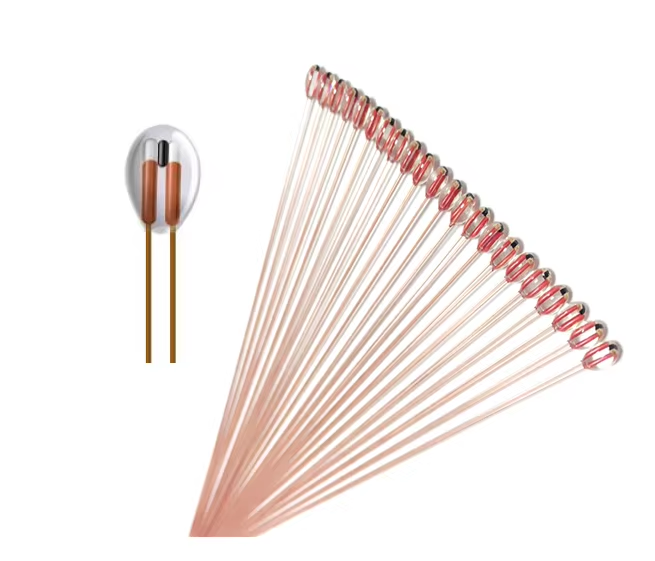
Low Parasitic Effects: The Core Advantage of Thin Film Thermistors
Thin-film thermistors are designed to reduce the known frequency-dependent problems of unwanted capacitance and inductance that disrupt high-frequency signals and, due to their sub-micron size, reduce capacitive coupling to < 0.1 pF and practically eliminate inductive interference. The essence of this effective combination of features is of paramount importance to RF designs, as perturbations of small signals can have an adverse effect on noise figure or generate annoying phase distortions in sensitive receiver systems. High-frequency design engineers have found that this set of features is extremely beneficial in the elimination of unwanted signals and the maintenance of high-quality, reliable signals in their designs.
Minimal Capacitance and Inductance for Clean RF Signal Integrity
These are all testable facts, Thin Film Thermistors have capacitance of less than 0.05 pF and inductance of less than 0.5 nH, all of which can be accounted for by the small metal tracks deposited on ceramic or glass surfaces using the sputtering technique. This results in no need for multiple electrodes or wire bond interconnections, as is typical in conventional thermistor designs. For wireless communication systems such as 5G or radar systems operating beyond 6 GHz, this degree of electrical silence is critical. It prevents impedance mismatches and improves signal integrity. The typical bead-type sensors result in an error vector magnitude (EVM) improvement of 15 to 40 percent which is quite a remarkable improvement and translates to significant improvement in clean data transmission.
Stable Impedance from 1 MHz to 10 GHz Without Resonant Degradation
These devices maintain a stable impedance of about +/- 2% across the entire RF bandwidth from 1 MHz to 10 GHz. This is simply unachievable with conventional bulk ceramic NTC/PTC thermistors. These devices typically exhibit unwanted resonant peaks above 100 MHz and can cause phase shifts of 20 degrees or more. With thin-film devices, this is due to the improved engineering of the thin-film self-resonance whereby the materials are more homogeneously applied and thinner (less than 5 micons +/-). Testing these devices across LTE bands has consistently shown their ability to operate, extend, and surpass millimeter wave frequencies as well. This allows engineers to reliably monitor power levels in beamforming arrays without needing constant recalibration, resulting in operational cost and time savings.

Sub-micro Thickness Materials Enable Nanosecond Scale Thermal Time Constants
Given a sub-micron thickness, materials demonstrate thermal time constants that are sub 100 nanoseconds, which is a dramatic improvement over standard thermistors. The low thermal mass coupled with a small thickness allows heat to move almost instantaneously within the sample and the sensor. Consider a thin film NiCr sensor with a thickness of 0.3 micrometers; this sensor exhibits a thermal time constant of approximately 40 nanoseconds. Such time constants are sufficient to capture the shorter thermal fluctuations corresponding to individual RF cycles in the gigahertz range. The challenge with many traditional sensor technologies is that they simply cannot respond rapidly enough to the fluctuations that are present, with time constants on the order of milliseconds rather than nanoseconds. This results in missed opportunities to monitor fast thermal fluctuations.
The Role of Response Speed in Bandwidth-Critical Applications (Pulsed RF, 5G NR)
The thin film thermistors used in 5G New Radio (NR) massive MIMO arrays perform real-time thermal monitoring as part of beamforming power amplifier failure protection during sub <25 μs transmission bursts. The nanosecond level response time enables:
- Prevention of thermal runaway and adjustment of power in pulsed RF systems
- Protection of GaN amplifiers in millimeter wave applications during < 1 ms duty cycles
- Thermal profiling of phased arrays in between 5G schedule gaps
The field trials demonstrated response time 200x faster than bead thermistors. This response time eliminated distortion in 3.5 GHz base stations and decreased thermal shutdown events by 74% per RF component reliability study from 2023. This close alignment on response time and bandwidth makes thin film thermistors critical for next generation terahertz communications, which will require rapid thermal feedback on the order of < 1 ms.
The impact of Precision Fabrication and Materials Science of Thin Film Thermistors
Sputtered NiCr, Pt, Oxides vs. Bulk Ceramics
Thanks to modern vacuum deposition techniques such as sputtering and vapor phase epitaxy, thin film thermistors can operate at high frequencies and high levels of performance. These techniques enable manufacturers to literally control film thickness and composition within a few tenths of a micrometer—an atomic level of control. Traditional sintered ceramic materials, on the other hand, have a number of limitations and challenges to their use. These materials have uneven grain boundaries, cause significant impedance drift due to porosity in the material, and fracture due to thermal shock. Sputtered materials, such as nickel chrome (NiCr), platinum (Pt), and many of the metal oxides, have a lot better stability and reliability in these regards.
Controlled TCR stability within ±50 ppm/°C from –55°C to +125°C
Direct thermal conduction paths, response latency reduced to <1 ms
Absence of binder materials, dielectric losses minimized 40% vs polymer-ceramic composites
This fabrication technique guarantees reliable thermal tracking in 5G beamforming modules and aerospace radar systems, where bulk materials fail.

Field-Validated Applications: Thin Film Thermistors in Modern RF Systems
5G Massive MIMO Power Amplifier Thermal Management (Keysight & Qorvo Case Data)
As 5G Massive MIMO base stations run at high frequencies with tightly packed antenna arrays, the base stations’ power amplifiers have serious heat issues. Thin film thermistors monitor temperature in real time without disrupting the signals to the extent that distortion would be an issue. Qorvo and Keysight have recently partnered to test the effects of thin film thermistors on improving thermal stability of 28 nm RF power amplifiers by approximately 32%. During high 5G New Radio load push stress tests, the equipment maintained temperature control, keeping the temperature below 85 °C during the heavy loading. The demonstrated performance offers substantial improvements to the operational effectiveness of 5G systems in deployment.
15% higher sustained throughput during peak loads
Reduced calibration drift in high-bandwidth scenarios
Extended PA lifespan under continuous 3.5 GHz operation
Case data supports thin film thermistors being integral to 5G thermal management solutions as ultrafast (dynamic response time < 100 ns) thermal management systems allowing for automated adjustments of power levels on the fly avoiding heat build up (thermal runaway) to prove that thin film thermistors are critical for the massive antenna array thermal management for 5G infrastructure.
FAQ
What are the advantages of using thin film thermistors in RF applications?
Thin film thermistors have low parasitic capacitance and inductance, RF signal integrity and clean RF channels, resonance free, along with a variety of impedance and bandwidth stability that translates to ultrafast (near instantaneous) thermal response time which allow real time monitoring without a negative impact on the RF signal.
In what manner do thin film thermistors benefit 5G technologies?
Thin film thermistors improve thermal management in 5G massive MIMO power amplifiers, enabling sustained throughput improvement and calibration drift reduction.
What benefits do thin film thermistors have over bulk ceramic thermistors?
Thin film thermistors utilize construction materials, such as NiCr and Pt, paired with advanced fabrication methods. Consequently, thin film thermistors are agile with minimal dielectric loss and possess thermal and impedance stability better than bulk ceramic thermistors.

