
 EN
EN



Reliable Operation Beyond 300°C Using Ceramic Composites and Doped Metal Oxides
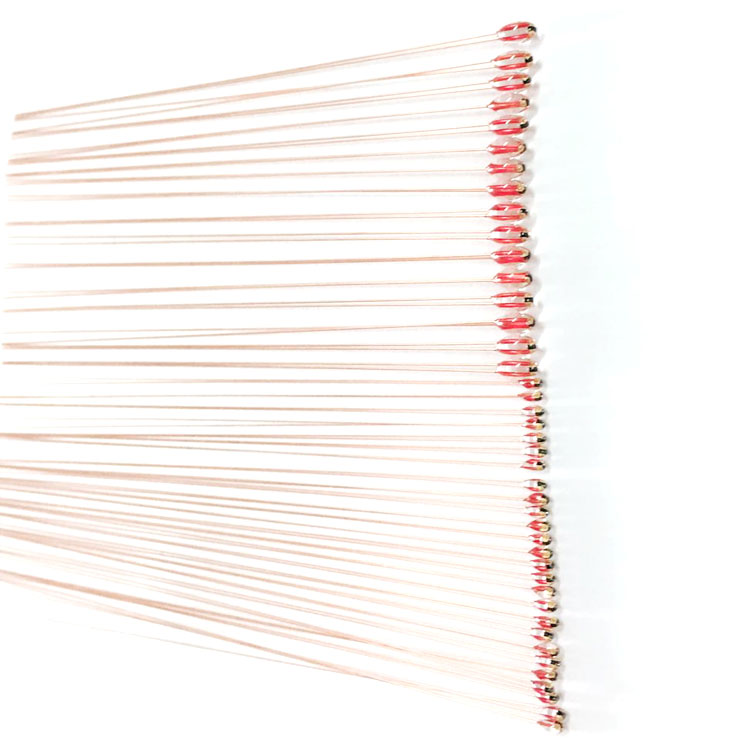
Thermistors of high temperatures use special ceramic composites (specifically, doped transition metal oxides using manganese-nickel-cobalt systems (MNC)) structures optimized for reliable operation over 300 degrees Celsius. All the activity of the semiconductor is confined to a specific crystal structure where ionic motion is not very free. Excess rare-earth elements in the mixture stabilize the composition within the thermistor and therefore thermal sensitivity, as a result, improves. Thermistor manufacturers report that, if the proper chemical composition is used, their thermistors will have a change in resistance of less than 0.5% over 5,000 thermal cycling tests (ASTM standards). Control bubble stabilizers from yttria stabilized zirconia and sintering in an oxygen-rich environment helps to achieve the desired microstructure. This microstructure will allow the thermistors to have a very low thermal stress cracking resistance when exposed to extreme thermal cycling.
Challenges with Heat-Fusion of Components over Time: Settling of Crystals
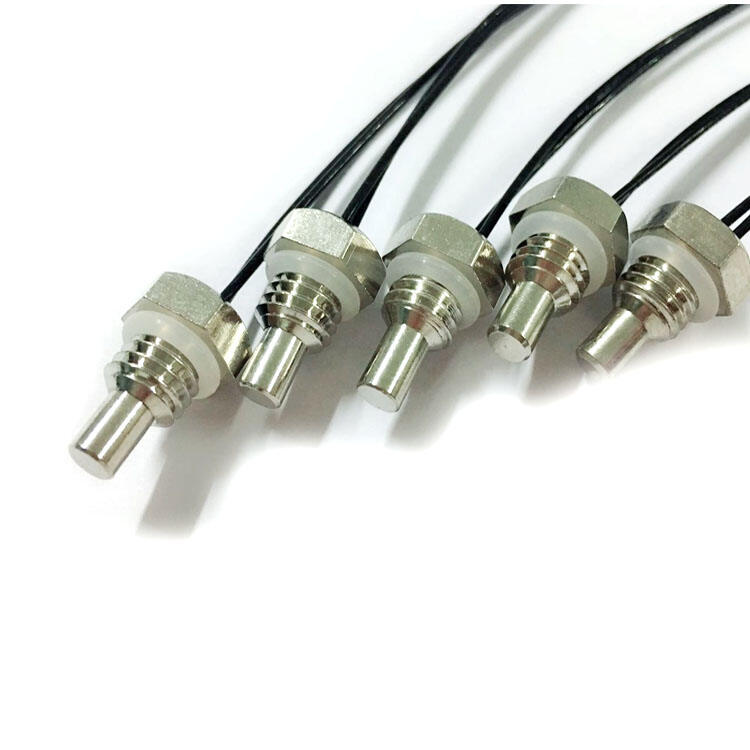
Crystalline settling has been found to be problematic when a solid is brought to a sufficiently high temperature for a prolonged amount of time. A leading countermeasure to this issue is known as multilayer co-firing. In multilayer co-firing, numerous layers of thermistors, as well as insulation, are fused together in a single sintering cycle (about 1,400 degrees Celsius) to form a homogenous, monolithic entity that is purposefully designed to counteract mechanical stress. The newest designs have been shown to reduce internal mechanical stress (within the entity) to below 50 percent of the amount that is typical (mean stress) for entities manufactured using conventional vertical stacking (post-processing stress measurements on co-fired entities were concluded in accordance with IEC 60539). After co-firing, the device is subjected to hermetic alumina encapsulation to create a vacuum (helium) tight seal. Test results show a helium leak rate of < 1 x 10^-8 atm cm^3/sec, which prevents gases (drift) from entering the encapsulation at temperatures above 250 degrees Celsius. The thermal expansion coefficients of the encapsulation material (alumina) and thermistor material are closely matched (within +/- 1.5 ppm/°C), which helps to suppress the movement of grain boundaries by ≥ 80 percent (after a prolonged service life).
These techniques mean that components can maintain their accuracy with less than 2% drift over 10,000 hours at full operating temperature.
Thermal Stability Performance Under Real-World Stress Conditions
High-temperature thermistors must not only keep accuracy in the lab, but also under the combined stresses of thermal cycling, chemical attack, and mechanical vibration in real-world scenarios.
Long-Term Drift Metrics: Resistance Change of Less Than 2% After 5,000 Hours at 250°C (IEC 60751-2)
IEC 60751-2 specifies the reliability standards that most companies hope to achieve. In describing the negative drift specifications, sensors that experience less than 2% resistance drift are said to have retained that drift after continuous use of 5,000 hours at 250 degrees Celsius. To validate these specifications, manufacturers conduct accelerated aging tests that simulate the environment the equipment will operate in. These tests include numerous climatic chambers to simulate various environments (e.g., hot and humid), and operate the equipment at full power to exceed specifications. The equipment’s operational temperature is also cycled rapidly (e.g., to 300 degrees in less than a minute). To achieve these results, manufacturers work with materials with stable crystal structures. The production of these materials requires specific doping, careful annealing to relieve built-up stresses, and a correct microstructure locked in to achieve the desired end.
Response Time–Accuracy Trade-Offs in High-Power Converter Thermal Monitoring
Choosing an appropriate thermistor when working with high power converters (>200 degrees Celsius) requires trade-offs with regards to response time versus the accuracy of the measurements. Thick film sensors provide response times of less than half a second which is quite good but have an accuracy drift of approximately 1.5 degrees Celsius with rapid changes in load. In contrast, some thermistor beads submerged in protective coatings have an accuracy of 0.3 degrees Celsius despite rapid changes in temperature over 50 degrees Celsius per second, however they have response times >3 seconds. In the case of protective elements in IGBT’s, the consequences of an error are quite severe, and may lead to unnecessary shut down of the system, or, conversely, device overheat and destruction. Most engineers consider this type of system design and accuracy of the measurements as a more critical parameter than the reaction time.
Applications of High Temperature Thermistors: Sensing and Protection
Motor Windings PTC Overtemperature Cutoffs with Sharp Switch Points (120°C - 200°C)
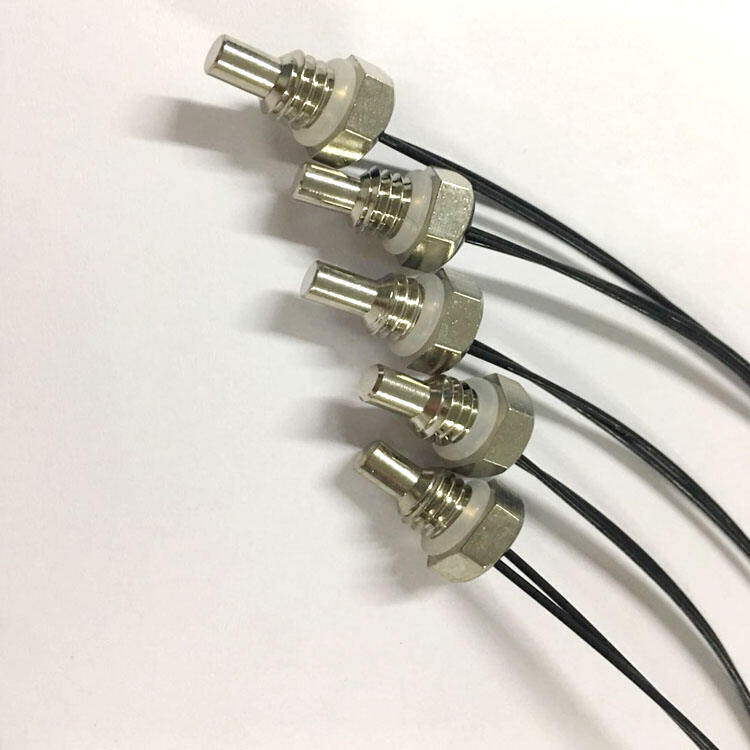
For an increasing number of industrial motors, PTC thermistors are becoming essential as internal protection devices for industrial motor windings. These devices are small and at rest are low resistance. Upon reaching a threshold temperature (typically between 120 and 200), they increase their resistance significantly, and interrupt the electrical circuit to prevent further increases in temperature and avoid damage. They are constructed in such a way that they do not cycle on and off with every temperature drop and rise. In the case of servo motors which can operate normally around 150°C, the majority of PTC thermistors used for protection, will be accurate to within +/- 5% for thousands of heating and cooling cycles. This is an accepted criterion for compliance with IEC 60751-2. They are designed from tough ceramics which allows them to withstand challenging environments where vibration is present. Because of these qualities, PTC thermistors can offer reliable thermal protection without the use of additional sensors or control systems.
Failure Mechanisms and Mitigation Strategies for High Temperature Thermistors
High temperatures pose distinct failure mechanisms for thermistors. These include repeated thermal cycling which causes differential micro-cracking due to differential expansion; heat induced alterations to resistive properties due to accelerated oxidation; seals which break down and shift calibration due to contaminants; and solder joint fatigue which is one of the major causes of electro-mechanical failure due to vibration.
We must begin with the materials to improve the mitigation strategies. Take substances such as doped ceramics, which can stop the troublesome rearrangement of crystal structures. There are also laser welded metal housings that provide near ideal sealing against environmental influences. There are also molybdenum disilicide interlayers which provide buffering for the different materials that expand at different rates with respect to temperature. In addition to other means, gold wire bonding is preferred over aluminum because it is better than aluminum at temperatures over +400 at which gold, the metal wire, or other materials, fail. However, the superior modern solutions are the ones that are not only relying on structural components. For example, engineers can detect damage before it spreads through embedded resistance monitoring. In these cases, the predictive nature of the approach is ideal because it is crucial in applications without redundancies.
Frequently Asked Questions
What materials are used in high-temperature thermistors?
High-temperature thermistors are typically made from ceramics because they can be constructed from doped transition metal oxide systems that rely on manganese, nickel, and cobalt, and are preferable for less failure at high temperatures.
What does multilayer co-firing mean in relation to thermistors?
With multilayer co-firing, alternating layers of thermistors and layers of insulation are fused in one co-firing operation, to create monolithic structures which are better able to accommodate strain than conventional methods.
How do PTC thermistors safeguard motor windings?
PTC thermistors provide self protection as they increase their resistance to an extent that the circuit gets interrupted to prevent any further damage.
Table of Contents
- Reliable Operation Beyond 300°C Using Ceramic Composites and Doped Metal Oxides
- Challenges with Heat-Fusion of Components over Time: Settling of Crystals
- Thermal Stability Performance Under Real-World Stress Conditions
- Applications of High Temperature Thermistors: Sensing and Protection
- Frequently Asked Questions

